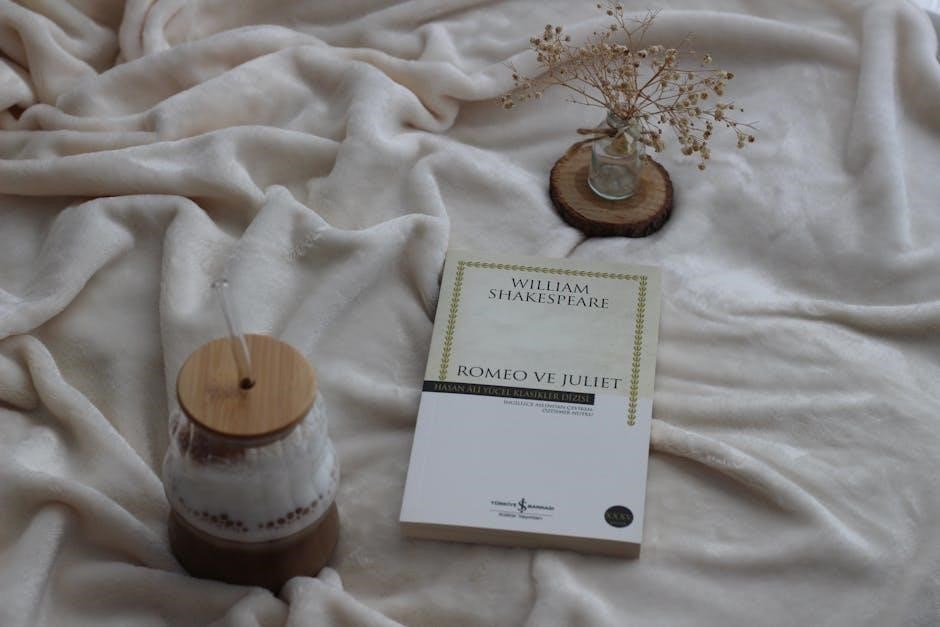
Romeo and Juliet Act 1: A Comprehensive Study Guide
This guide delves into Act 1, exploring feuding families, initial conflicts, and Romeo’s melancholy․
It examines key scenes,
character introductions, and foreshadowing elements within the play’s opening act․
William Shakespeare’s Romeo and Juliet is a timeless tragedy centered around two young lovers caught in a bitter feud between their families, the Montagues and Capulets․ Act 1 immediately plunges the audience into the heart of Verona’s unrest, establishing the volatile atmosphere that fuels the play’s dramatic events․
The Chorus serves as a narrator, swiftly summarizing the longstanding conflict and foreshadowing the tragic fate of the “star-cross’d lovers․” This opening sets a tone of inevitability, hinting at the play’s ultimate outcome․ Act 1 skillfully introduces key characters – Romeo, consumed by unrequited love for Rosaline, and the fiery Tybalt, eager to ignite conflict․
Through a public brawl and preparations for the Capulet feast, Shakespeare masterfully establishes the social and political landscape of Verona, while simultaneously laying the groundwork for the fateful encounter between Romeo and Juliet․ The act’s conclusion, with Romeo’s melancholic state, builds anticipation for the transformative events to come․
The Feuding Families: Montagues vs․ Capulets
The animosity between the Montagues and Capulets is the central conflict driving Romeo and Juliet․ Act 1 immediately showcases this deep-seated hatred through the violent street brawl initiated by Sampson and Gregory of the Capulet household, and Benvolio’s attempt to intervene․ The origins of the feud remain largely unexplained, emphasizing its irrational and enduring nature․
This longstanding conflict permeates Veronese society, disrupting public peace and influencing the lives of all its citizens․ The Prince’s stern decree – threatening death for any further disturbances – underscores the severity of the situation and the powerlessness of individuals against this entrenched animosity․
The families’ rivalry isn’t merely a backdrop; it actively shapes the narrative, creating obstacles for Romeo and Juliet’s burgeoning love․ Their forbidden connection is a direct consequence of this inherited hatred, ultimately leading to the play’s tragic climax․ The feud represents a destructive cycle of violence and revenge․
The Chorus and its Role in Setting the Scene
Shakespeare employs the Chorus in Romeo and Juliet as a narrative device, functioning much like a prologue to each act․ In Act 1, the Chorus directly addresses the audience, providing crucial exposition about the play’s central conflict – the ancient grudge between the Montagues and Capulets – and foreshadowing the tragic fate of the “star-cross’d lovers․”
The Chorus doesn’t simply tell the story; it frames it, establishing a sense of inevitability and dramatic irony․ By revealing the play’s outcome upfront – the lovers’ deaths and the families’ reconciliation – the Chorus shifts the audience’s focus from what will happen to how it will happen․

This technique heightens dramatic tension and encourages the audience to analyze the characters’ choices and the forces driving the tragedy․ The Chorus acts as a detached observer, offering a broader perspective on the unfolding events and emphasizing the play’s themes of fate and free will․
Act 1, Scene 1: The Street Brawl
The play explodes into action with a chaotic street fight in Verona’s public square, immediately establishing the deep-seated animosity between the Montague and Capulet families․ Sampson and Gregory, Capulet servants, initiate the conflict, provoking Abram and Balthasar, Montague servants, through insults and physical aggression․
This opening brawl isn’t merely senseless violence; it’s a public display of the families’ long-standing hatred, disrupting the peace of the city․ The Prince’s intervention underscores the severity of the feud, issuing a stern decree threatening death to anyone who disturbs the peace again․
The scene serves to quickly immerse the audience in the play’s central conflict and highlights the volatile atmosphere of Verona․ It also introduces key characters and establishes the stakes – the consequences of continuing this bitter rivalry are dire, foreshadowing the tragedy to come․
Analyzing the Characters of Sampson and Gregory
Sampson and Gregory, Capulet servants, function as both instigators and comic relief in Act 1, Scene 1․ Their opening dialogue is filled with crude jokes and boasts, revealing their eagerness to engage in the feud, even if it means bending the rules or exaggerating their bravery․ They are passionate, but in an aggressively immature way․
Shakespeare utilizes them to demonstrate the pervasive nature of the Montague-Capulet hatred; it has seeped down to the lowest levels of society․ Their attempts at intimidation are often clumsy and reveal a lack of genuine courage, relying instead on bravado and the security of being in a group․
However, their characterization isn’t solely for comedic effect․ They represent the blind loyalty and ingrained prejudice that fuel the conflict, highlighting how easily violence can be sparked by inherited animosity․ Their actions directly lead to the escalation of the brawl, setting the stage for the Prince’s intervention․
Benvolio’s Attempt to Keep the Peace
Benvolio, a Montague, stands in stark contrast to the aggressive Sampson and Gregory․ He is presented as a peaceable character, actively attempting to diffuse the escalating conflict in Act 1, Scene 1․ He draws his sword not to fight, but to separate the brawling servants, demonstrating a clear desire to avoid violence․
His concern for Romeo’s well-being is immediately apparent, as he tries to understand the source of Romeo’s sadness – “good hearts oppression․” Benvolio’s compassionate nature and level-headedness make him a foil to the hot-headed Tybalt and the impulsive servants․
Despite his efforts, Benvolio is ultimately unable to prevent the brawl from spiraling out of control, highlighting the deeply rooted animosity between the families․ His attempts at peacemaking underscore the futility of reason in the face of such entrenched hatred, yet establish him as a voice of moderation within the play․

The Prince’s Decree and its Significance
The Prince’s intervention in Act 1, Scene 1, following the street brawl, is a pivotal moment establishing the stakes and foreshadowing the play’s tragic outcome․ He delivers a stern decree, declaring that any further public disturbances will be met with death – a punishment for all involved, not just the initial instigators․
This decree isn’t merely a threat; it represents the authority of the state attempting to maintain order in a city fractured by a long-standing feud․ It highlights the consequences of the Montague-Capulet conflict extending beyond personal grievances and disrupting civic peace․
The Prince’s words serve as a dramatic warning, a clear indication that the escalating violence will not be tolerated․ This foreshadows the ultimate price Romeo and Juliet will pay, as their love blossoms amidst this forbidden conflict, and tragically violates the Prince’s law․
Act 1, Scene 2: Capulet’s Party Plans
This scene centers around Lord Capulet’s preparations for a grand feast, a significant social event in Verona․ He’s initially hesitant about Juliet marrying Paris so young, desiring her happiness and a match based on more than just social standing․ However, he ultimately agrees to host the party, believing it will provide an opportunity for Juliet and Paris to become acquainted․
The party serves as a crucial plot device, setting the stage for Romeo and Juliet’s fateful first encounter․ Capulet’s desire to maintain peace at the party is also established, foreshadowing his later reaction to Romeo’s presence․
Importantly, the scene introduces the character of the Servant, tasked with delivering invitations, whose illiteracy provides a moment of comic relief while also highlighting the social dynamics of the time․
Paris’s Suit for Juliet’s Hand
Count Paris formally requests Lord Capulet’s permission to marry Juliet, presenting himself as a suitable and noble match․ He is a wealthy and well-respected suitor, favored by Juliet’s parents for the advantageous alliance the marriage would create․ However, Capulet, while receptive to the idea, expresses caution, acknowledging Juliet’s young age – barely fourteen – and suggesting she needs time to consider such a significant commitment․
This initial proposal establishes Paris as a foil to Romeo; he represents a socially acceptable, pragmatic union, contrasting sharply with the passionate, impulsive love that will blossom between Romeo and Juliet; Capulet’s hesitation, though ultimately overruled by his desire to see Juliet settled, hints at a paternal concern beyond mere social climbing․
The scene subtly highlights the limited agency Juliet possesses in matters of marriage, a common societal constraint of the era․
Capulet’s Hesitation and Reasoning
Lord Capulet, despite appearing amenable to Paris’s suit, initially displays a surprising reluctance to immediately consent to the marriage․ He voices concern over Juliet’s youth, stating she is still a “tender maid” and barely fourteen years of age․ He fears rushing her into a commitment of such magnitude, suggesting she needs time to experience life and consider whether she truly desires marriage․
This hesitation isn’t solely rooted in paternal affection; Capulet also acknowledges the importance of Juliet’s happiness․ He doesn’t want to force a union upon her that she might later regret․ However, his reasoning is also influenced by societal expectations and the desire to secure a beneficial match for his daughter, ultimately prioritizing social standing alongside her well-being․
His eventual agreement to the marriage plans, spurred by the prospect of a grand feast, reveals a complex character driven by both love and social ambition․
The Servant’s Illiteracy and Comic Relief
Shakespeare masterfully employs the Capulet servant, tasked with delivering invitations to the feast, as a source of comic relief․ The servant, unable to read, relies on memorizing the names of the guests from the guest list․ This leads to a humorous scene where he struggles to recall who is invited and frequently misinterprets instructions․
His attempts to decipher the list, coupled with his boastful claims of literacy, create a farcical situation․ He asks Romeo and Benvolio for assistance in reading the names, unknowingly inviting uninvited guests – the Montagues – to the Capulet’s party․ This unintentional act sets in motion a crucial plot point․
This comedic interlude not only provides lightheartedness but also highlights the social disparities of the time, contrasting the educated nobility with the illiterate commoners․
Act 1, Scene 3: Lady Capulet and the Nurse
This scene centers on Lady Capulet’s attempt to inform Juliet of the potential marriage to Paris․ However, the scene is largely dominated by the Nurse, who provides a lengthy and rambling account of Juliet’s childhood․ Her anecdotes, though seemingly digressive, reveal a deep affection for Juliet and offer insight into her upbringing․
Lady Capulet approaches the topic of marriage with formality and a focus on social standing, viewing Paris as a suitable match due to his wealth and nobility․ In contrast, the Nurse’s perspective is more grounded and practical, reminiscing about Juliet’s physical development․
The scene establishes a clear contrast between the mother’s reserved demeanor and the Nurse’s boisterous personality, highlighting their differing roles in Juliet’s life and foreshadowing their contrasting advice․
Juliet’s Age and Perspective on Marriage
Juliet is presented as remarkably young in Act 1, barely thirteen years of age, making her impending marriage to Paris particularly unsettling․ Despite her youth, Juliet demonstrates a surprising level of maturity and thoughtfulness when considering the prospect of wedlock․
Initially, she agrees to consider Paris, showing respect for her mother’s wishes․ However, she expresses a willingness to look at him before committing, indicating a desire for agency in a decision that will profoundly impact her life․ This subtle resistance reveals a nascent independence․
Juliet’s perspective differs significantly from the pragmatic views of Lady Capulet and the Nurse․ She hasn’t yet internalized the societal pressures surrounding marriage, and her response suggests a preference for personal choice over familial obligation․ This sets the stage for her later defiance․
The Nurse’s Role as a Confidante
In Act 1, the Nurse emerges as a central figure in Juliet’s life, functioning as a maternal substitute and, crucially, a confidante․ Her lengthy monologue recounting Juliet’s childhood reveals a deep, affectionate bond – she has practically raised Juliet․ This established intimacy is vital for the play’s unfolding events․
The Nurse provides a contrasting perspective to Lady Capulet’s formality․ She’s earthy, talkative, and openly shares personal anecdotes, creating a comfortable space for Juliet to express herself․ While initially focused on practical matters like Juliet’s upbringing, the Nurse quickly becomes a sounding board for Juliet’s thoughts and feelings․
Her willingness to discuss marriage, albeit with a pragmatic and somewhat bawdy tone, demonstrates her accessibility․ This foreshadows her later role as a messenger and facilitator in Juliet’s relationship with Romeo, making her a key player in the secret romance․
Act 1, Scene 4: Romeo’s Melancholy
Scene 4 is pivotal in establishing Romeo’s character and emotional state before he meets Juliet․ He is consumed by an intense, yet unrequited, love for Rosaline, wallowing in a dramatic melancholy․ His language is filled with Petrarchan conceits – exaggerated expressions of suffering – portraying love as a painful, almost religious experience․

Romeo’s despair is so profound that he expresses a desire to remain hidden from the world, highlighting his isolation and emotional turmoil․ Benvolio, concerned for his friend, attempts to reason with him, suggesting he forget Rosaline and find another love․ This sets up Benvolio’s plan to attend the Capulet feast․
Shakespeare skillfully uses Romeo’s sadness to create anticipation․ By ending the scene with Romeo’s melancholy, the audience anticipates a transformative encounter․ This clever structuring keeps the audience engaged, eager to witness how Romeo’s perspective will shift․
Romeo’s Unrequited Love for Rosaline
Romeo’s initial infatuation with Rosaline is presented as a conventional, stylized courtly love․ He suffers from a typical Petrarchan lover’s complaint: his affections are not returned․ He describes his love as a source of pain and frustration, using elaborate metaphors and hyperbole to express his despair․ He states, “She hath foresworn to love․”
This unrequited love serves as a crucial plot device, establishing Romeo’s predisposition to romantic intensity and his tendency towards melancholy․ It also highlights the contrast between his initial, superficial love for Rosaline and the profound, genuine love he will later experience with Juliet․
Shakespeare uses this early heartbreak to demonstrate the theme of love as both a source of joy and suffering․ Romeo’s dramatic pronouncements, while seemingly excessive, foreshadow the tragic consequences of passionate love that will unfold throughout the play․
Benvolio’s Plan to Distract Romeo
Recognizing Romeo’s profound sadness over Rosaline, Benvolio attempts to alleviate his friend’s suffering through a practical and well-intentioned plan․ He suggests attending the Capulet feast, believing that observing other beautiful women will help Romeo forget his unrequited love․ Benvolio expresses his sadness for Romeo’s “good heart’s oppression․”
This plan isn’t merely a superficial attempt at cheering Romeo up; it’s a calculated strategy to shift his focus and demonstrate that Rosaline isn’t unique․ Benvolio hopes to prove to Romeo that there are other worthy objects of affection․ He believes a change of scenery and new faces will offer a perspective shift․
Ironically, Benvolio’s plan, intended to cure Romeo of love, inadvertently leads him to Juliet, initiating the central romance of the play․ This highlights the role of fate and the unpredictable nature of love within the narrative․
The Theme of Love and Sadness
Act 1 immediately establishes a complex interplay between love and sadness, setting a melancholic tone for the tragedy to unfold; Romeo’s initial state is defined by unrequited love for Rosaline, depicted as a source of profound sorrow and despair․ He laments that love, “so gentle in his view, should be so tyrannous and rough in proof!”
This early portrayal of love as painful contrasts sharply with the potential for joyous love hinted at later in the act․ The feud between the Montagues and Capulets also introduces a destructive form of “love” – loyalty to family – that breeds hatred and violence․
Shakespeare masterfully uses language to convey the intensity of both emotions․ Romeo’s poetic expressions of sadness foreshadow the tragic consequences of passionate love, while the brawl demonstrates the destructive power of misplaced affection․ The act establishes love as a force capable of both exquisite joy and devastating pain․
Act 1, Scene 5: The Capulet Feast

This scene is pivotal, marking the first encounter between Romeo and Juliet․ Despite the ongoing feud, the Capulet’s host a lavish feast, providing a public yet intimate space for the fateful meeting․ Romeo, initially hesitant to attend, is persuaded by Benvolio, hoping to distract him from Rosaline․

The moment Romeo and Juliet see each other, they share a sonnet, a poetic exchange signifying immediate and profound connection․ This shared verse emphasizes the intensity and destined nature of their love․ However, Tybalt recognizes Romeo as a Montague and is enraged by his presence, demanding action against the intruder․
Capulet, desiring to maintain peace at his party, intervenes and prevents Tybalt from causing a scene․ This act of restraint foreshadows the escalating conflict and the challenges Romeo and Juliet will face․ The scene concludes with both characters discovering each other’s identities, adding a layer of forbidden longing to their burgeoning romance․
Romeo and Juliet’s First Meeting

Their initial encounter at the Capulet feast is electric and transformative․ Before this moment, Romeo is consumed by unrequited love for Rosaline, portraying a melancholic and idealized view of romance․ However, upon seeing Juliet, his feelings instantly shift, demonstrating a powerful and immediate connection․
Shakespeare masterfully uses the sonnet form to depict their first exchange, with each character completing the other’s lines․ This poetic dialogue symbolizes their destined union and the harmonious blending of their souls․ It’s a moment of pure, innocent attraction, untouched by the knowledge of their families’ animosity․

This meeting is significant as it establishes the central conflict of the play: a love born amidst hatred․ The scene is also notable for its private quality within a public setting, highlighting the intimacy and secrecy that will characterize their relationship․ It’s a turning point, shifting the play’s focus to their forbidden love․
Tybalt’s Recognition of Romeo and his Fury
Tybalt’s reaction to Romeo’s presence at the Capulet feast is explosive and foreshadows future tragedy․ He immediately recognizes Romeo as a Montague, a member of the family he despises, and is consumed by rage; This isn’t merely familial loyalty; Tybalt embodies the deep-seated hatred fueling the feud․
His initial desire is to immediately seek revenge and draw his sword, demonstrating his hot-headed and aggressive nature․ However, Capulet intervenes, preventing a scene and prioritizing maintaining peace at his own party․ This restraint frustrates Tybalt, who views Capulet’s actions as a sign of weakness․
Tybalt’s fury is crucial because it establishes him as a primary antagonist․ He represents the unwavering commitment to the feud and the destructive consequences of unchecked anger․ His vow to avenge Romeo’s intrusion sets in motion a chain of events leading to the play’s tragic climax, highlighting the dangers of inherited hatred․
Capulet’s Intervention and Maintaining Peace
Lord Capulet’s response to Tybalt’s outrage at Romeo’s presence is a pivotal moment, revealing his character and priorities․ Despite Tybalt’s vehement demand for immediate retribution, Capulet firmly insists on maintaining peace at his own feast․ He prioritizes hospitality and avoids a public disruption, showcasing a degree of reason and control․
Capulet’s reasoning is multifaceted; he doesn’t want to appear rude to the visiting guests, and he believes Romeo poses no immediate threat․ He subtly rebukes Tybalt, accusing him of being overly sensitive and suggesting he swallow his pride․ This intervention temporarily diffuses a potentially violent situation․
However, Capulet’s decision also carries dramatic irony․ While intending to preserve order, he unknowingly allows the seeds of tragedy to be sown․ His attempt to maintain peace ultimately delays, but doesn’t prevent, the inevitable conflict, highlighting the complexities of fate and free will within the play․
The Significance of Romeo and Juliet’s Sonnet
The sonnet exchanged between Romeo and Juliet upon their first meeting is arguably the most famous in English literature, and its significance is profound․ It’s not merely a display of poetic skill, but a symbolic representation of their immediate and overwhelming connection․ The perfectly structured fourteen lines mirror the perceived perfection of their love at first sight․
The sonnet’s religious imagery – references to saints and pilgrimage – elevates their love to a spiritual level, suggesting it’s a sacred and destined encounter․ They complete each other’s lines, demonstrating a harmonious unity and a shared understanding that transcends words․
This shared sonnet foreshadows their intertwined fate and the intensity of their passion․ It establishes a poetic language for their love, which will continue to be expressed through verse throughout the play, even as tragedy unfolds․ It’s a moment of pure beauty amidst the backdrop of familial hatred․
Key Themes Introduced in Act 1
Act 1 of Romeo and Juliet masterfully introduces several core themes that resonate throughout the play․ The most prominent is, of course, the destructive power of feud and hatred, vividly illustrated by the opening street brawl between the Montagues and Capulets․ This conflict establishes a volatile atmosphere and highlights the senselessness of their long-standing animosity․
Love, particularly passionate and impulsive love, is also immediately presented, initially through Romeo’s infatuation with Rosaline, and then dramatically with his instant connection to Juliet․ This contrast emphasizes the transformative power of true love․
Fate and destiny are subtly woven into the narrative, hinted at by the Chorus’s prologue, which reveals the tragic outcome․ The theme of conflict between individual desire and societal expectations also emerges, foreshadowing the obstacles Romeo and Juliet will face․
Foreshadowing of Future Events
Act 1 is rich with foreshadowing, subtly hinting at the tragedy to come․ The Chorus’s prologue explicitly reveals the fate of “two star-cross’d lovers,” immediately establishing a sense of impending doom․ This direct statement primes the audience for a tragic outcome, creating dramatic irony․
The violent opening brawl foreshadows further conflict and bloodshed, suggesting the feud will escalate with devastating consequences․ Tybalt’s fiery reaction to Romeo’s presence at the Capulet feast foreshadows his role as a key instigator of violence․
Romeo’s melancholy and expressions of love’s pain before meeting Juliet subtly foreshadow the suffering he will endure․ The play’s language itself, filled with references to death and darkness, contributes to this sense of foreboding, preparing the audience for the lovers’ ultimate fate․
Character Development in Act 1
Act 1 establishes crucial character foundations․ Romeo is introduced as a melancholic lover, consumed by unrequited affection for Rosaline, showcasing his passionate yet immature nature․ Benvolio emerges as a peacemaker and loyal friend, contrasting sharply with the aggressive Sampson and Gregory, who embody the feud’s petty violence․
Tybalt is presented as hot-headed and quick to anger, foreshadowing his antagonistic role․ Juliet, though young, demonstrates a respectful obedience to her parents, yet hints at independent thought․ The Nurse is revealed as a warm, earthy figure, providing a maternal counterpoint to Lady Capulet’s formality․

These initial portrayals are not static; characters begin to reveal complexities․ Romeo’s shift from Rosaline to Juliet suggests a capacity for profound change, while the Prince’s stern decree highlights the consequences of unchecked passion and familial hatred․

Motifs and Symbols in Act 1
Act 1 introduces recurring motifs and potent symbols․ The pervasive theme of light and darkness is subtly present, foreshadowing the lovers’ destined, yet potentially tragic, connection․ The feud itself functions as a symbol of irrational hatred and societal decay, driving much of the initial conflict․
The summer’s heat in Scene 1 mirrors the rising tensions and volatile tempers of the characters, creating a sense of impending doom․ Romeo’s melancholy and references to sadness symbolize the pain of unrequited love and the play’s overarching tragic tone․
The sonnet shared between Romeo and Juliet upon their first meeting symbolizes their immediate and destined connection, a perfect poetic form reflecting their perfect love․ The Capulet feast itself represents a public space where forbidden desires blossom, setting the stage for future complications․